The J15 card for Jana 965
A stock card for the Jana 965, included with every copy. A circuit model, solved part by part.
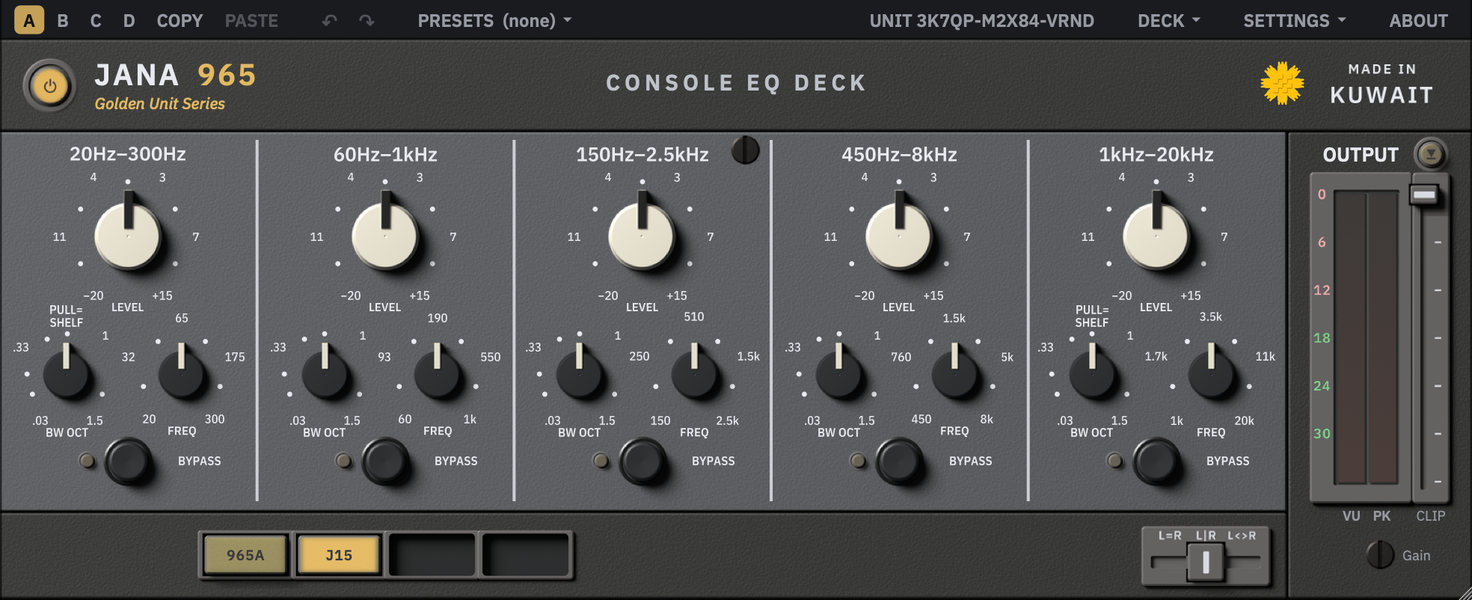
Surgical. The J15 is five fully parametric bands whose bells go as narrow as 0.03 of an octave and cut up to 20 dB. Reach for it to fix one narrow thing in a sound: a ringing note, a hum, a whistle.
Its five bands are summed in parallel, and it is modelled from the published schematic of a mid-1980s five-band parametric equaliser, part by part, with the drawing's own values. Our claim is fidelity to that circuit as it is drawn, not to one measured unit of it. It runs at zero latency, at the host's own rate.
| Card | The J15 card for Jana 965 |
|---|---|
| Deck | Jana 965 |
| Kind | Circuit model |
| Comes with | The Jana 965, as a stock card: in the trial and in every licence |
| Price | Included in the Jana 965 ($59 at release) |
| Availability | Announced, not yet released. Release date to be announced. |
| Formats | Planned for version 1.0: macOS (VST3, AU and AAX) and Windows (VST3 and AAX) |
| Latency | Zero |
| System requirements | The Jana 965’s: see its facts |
Good for
- Notching a resonance or a ringing note. At its narrowest, a band at full cut measures 0.030 to 0.036 of an octave between its −3 dB points, depending on the band: under half a semitone. The cut goes 20 dB deep.
- Several problems close together. The five bands' ranges overlap. From about 60 Hz to about 8 kHz at least two bands reach any frequency, and across most of the stretch from 150 Hz to 2.5 kHz, three.
- Carving space for a vocal. Set a cut of any width from 0.03 of an octave to an octave and a half, and it does not broaden as you back it off: measured between half-gain points, the narrowest band 3 is 0.045 of an octave wide at −4 dB and 0.11 at −20.
- Working two bands on one area. The bands are summed, so overlapping boosts blend instead of piling up: two full boosts on one frequency reach +20.2 dB, not +30.
- Big shelf moves at either end. Bands 1 and 5 pull to shelves that go past the dial: measured as far as +17.8 / −23.6 dB at the bottom and +19.5 / −25.0 dB at the top.
Less suited to broad, gentle tone-shaping, and to filtering. Its widest bell is an octave and a half, where the 965A's is two and a half. It has no high-pass or low-pass filter to set. And LEVEL moves fastest near zero, so its smallest moves are coarser than the 965A's. For those, reach for the 965A.
The controls
| Band | Frequency | Level | Bandwidth |
|---|---|---|---|
| 1 | 20 Hz – 300 Hz | −20 to +15 dB | 0.03 – 1.5 octaves, or shelf |
| 2 | 60 Hz – 1 kHz | −20 to +15 dB | 0.03 – 1.5 octaves |
| 3 | 150 Hz – 2.5 kHz | −20 to +15 dB | 0.03 – 1.5 octaves |
| 4 | 450 Hz – 8 kHz | −20 to +15 dB | 0.03 – 1.5 octaves |
| 5 | 1 kHz – 20 kHz | −20 to +15 dB | 0.03 – 1.5 octaves, or shelf |
- LEVEL boosts up to 15 dB or cuts up to 20 dB. Its centre is flat. Like the centre-tapped pots in the circuit it models, it changes fastest near 0 dB: within about two degrees of the centre, a band already cuts by about 1.4 dB or boosts by about 0.75 dB.
- FREQ sets the band's centre.
- BW sets the band's width, from 0.03 of an octave to an octave and a half.
- PULL=SHELF turns bands 1 and 5 into shelves: option-click the BW knob, or click the legend, which lights. In shelf mode BW does nothing.
- BYPASS takes one band out, and its lamp shows it.
There are no filters on this card. The output stage, the meter, VAR and the stereo modes are the frame's, the same on every card.
The dials print what the original prints. Its numerals, range titles and words, set in our own type at the original's angles. Each pot's law is modelled, fitted through those printed numerals, and the readouts say what the model does at every setting.
Its character
The bands are summed, not chained. All five bands work side by side on one signal and their effects are added together, rather than one band feeding the next. Two bands boosting the same frequency therefore do not stack the way two chained equalisers would: measured on the plugin, two bands at full boost on the same 510 Hz reach +20.2 dB, not +30. Two full cuts likewise reach −25.6 dB, not −40. Wherever bands overlap they interact this way, which is why the model sums them as the circuit does rather than chaining them.
Constant-Q. A band's width does not change as you turn its level, which is the opposite choice from the 965A's proportional-Q bells. Read off the curve, a small move is never broader than a large one: between half-gain points, band 3 at its narrowest measures 0.04 of an octave at +3 dB and 0.08 at +15, where the 965A's narrowest bell is 0.92 of an octave wide at ±2.4 dB.
More cut than boost. The level dial runs from −20 to +15 dB, and the measured peaks reach +14.96 and −20.04 dB.
The shelves go further than the bells. Pulled to shelf, band 1 reaches +17.8 / −23.6 dB and band 5 +19.5 / −25.0 dB on the plugin, past the dial's printed +15 and −20, as the circuit does. A shelf's corner moves with FREQ and with LEVEL, and it is not the numeral the dial points at: with band 1 on "175" the boost's half-gain point is near 200 Hz.
At rest, it is the circuit as drawn. With every level at zero the J15 plays the schematic's own rest path, including the infrasonic filter it draws at 15 Hz: measured, 0.7 dB down at 20 Hz and within 0.11 dB of flat everywhere above 40 Hz. VAR reaches those fixed parts too, so a drawn unit varies at rest as well.
The narrowest setting. The dial prints .03 of an octave, and bands 1 and 5 reach it. The circuit's own parts stop bands 2 to 4 at 0.035, and the model does the same. Measured on the plugin between the −3 dB points, at full boost and at full cut: 0.031 and 0.030 of an octave on bands 1 and 5, and about 0.036 on bands 2 to 4. The widest setting measures 1.5 octaves.
Frequency response
Each curve below is measured on the plugin itself: an impulse through the 965's release candidate at 48 kHz, offline, with the J15 in circuit and the settings shown under each figure, and everything else at the card's defaults. Nothing in these figures is drawn by hand or taken from a design curve.
| Curve | Setting | Measured |
|---|---|---|
| 1 | LEVEL +15, FREQ 65 Hz, BW .72 oct | +14.93 dB at 65.5 Hz |
| 2 | LEVEL +15, FREQ 190 Hz, BW .72 oct | +14.96 dB at 190 Hz |
| 3 | LEVEL +15, FREQ 510 Hz, BW .72 oct | +14.96 dB at 510 Hz |
| 4 | LEVEL +15, FREQ 1.5 kHz, BW .72 oct | +14.95 dB at 1.50 kHz |
| 5 | LEVEL +15, FREQ 3.5 kHz, BW .72 oct | +14.93 dB at 3.50 kHz |
| Curve | Setting | Measured |
|---|---|---|
| BW .03 | LEVEL +15, FREQ 510 Hz, BW at its narrow stop (.03 printed) | +14.96 dB at 510 Hz |
| BW .03 | LEVEL −20, the same | −20.04 dB at 510 Hz |
| BW .33 | LEVEL +15, FREQ 510 Hz, BW .33 oct | +14.96 dB at 510 Hz |
| BW .33 | LEVEL −20, the same | −20.04 dB at 510 Hz |
| BW 1 | LEVEL +15, FREQ 510 Hz, BW 1 oct | +14.96 dB at 510 Hz |
| BW 1 | LEVEL −20, the same | −20.04 dB at 510 Hz |
| BW 1.5 | LEVEL +15, FREQ 510 Hz, BW 1.5 oct | +14.96 dB at 510 Hz |
| BW 1.5 | LEVEL −20, the same | −20.03 dB at 510 Hz |
| Curve | Setting | Measured |
|---|---|---|
| Band 1 shelf | PULL=SHELF, LEVEL +15, FREQ on 175 | +17.77 dB at 28.5 Hz; half-gain point 198 Hz |
| Band 1 shelf | PULL=SHELF, LEVEL −20, FREQ on 175 | −23.64 dB at 20.0 Hz; half-gain point 250 Hz |
| Band 5 shelf | PULL=SHELF, LEVEL +15, FREQ on 1.7k | +19.45 dB at 18.6 kHz; half-gain point 1.56 kHz |
| Band 5 shelf | PULL=SHELF, LEVEL −20, FREQ on 1.7k | −24.97 dB at 18.9 kHz; half-gain point 1.15 kHz |
| Curve | Setting | Measured |
|---|---|---|
| At rest | Every LEVEL at 0 | −0.70 dB at 20.0 Hz; at most +0.05 dB elsewhere |
| Band 3 alone | Band 3 LEVEL +15, FREQ 510 Hz | +14.96 dB at 510 Hz |
| Band 3 alone | Band 3 LEVEL −20, FREQ 510 Hz | −20.04 dB at 510 Hz |
| Bands 2 and 3 | Bands 2 and 3 LEVEL +15, both on 510 Hz | +20.17 dB at 510 Hz |
| Bands 2 and 3 | Bands 2 and 3 LEVEL −20, both on 510 Hz | −25.61 dB at 510 Hz |
What it is modelled on
The J15 is Jana Audio's emulation of a vintage program equaliser: a mid-1980s five-band parametric equaliser, modelled from its published schematic. It is not affiliated with or endorsed by the original's maker, and it carries no name, logo or model number of the original. Its name follows our rule: 965 for our own designs, J and a number for the circuits we model from someone else's drawing.
Phase as well as magnitude. Because the bands are summed, a sum depends on phase as much as on level, so the model follows the circuit's phase too, at zero latency and at the host's rate.
Limits we state
- At the top of the audio band. No filter without latency can follow the circuit's phase all the way to 20 kHz at 44.1 or 48 kHz, where several wide bands overlap. At those rates the model can differ from the circuit by up to 2.28 dB (44.1 kHz) and 2.11 dB (48 kHz) at the worst of over a thousand settings tested, and by 2.38 dB at one setting found by a deliberate search. Higher rates close the gap: 1.02 dB at 96 kHz, 0.48 dB at 192 kHz.
- The two lowest bands, swept narrow. Sweeping FREQ at the narrowest bandwidth, low in the band, gives a slightly different colour from the circuit's while the knob moves. It is not a burst, and the sound settles to the circuit's once the knob stops.
- Heavily automated, playing live. With many J15 controls automated at once, a move can now and then take effect one buffer late while the session plays, so the playback differs briefly from a bounce of the same passage. An offline bounce is always exact, and two bounces are always identical.
The Jana 965 page lists every stated limit, and the manual gives each one with its figures.
Price and ownership
The J15 is a stock card: it comes with the Jana 965, in the trial and in every licence, at no extra cost, and it ships inside the plugin. Cards beyond the two stock cards will be add-ons, each with a page like this one and its price on it.